

NEMA 14-50 vs NEMA 6-50: Which Outlet Do You Need for Your EV Charger?
When preparing your home for Level 2 EV charging, the outlet type matters more than most buyers expect. NEMA 14-50 and NEMA 6-50 are the two most common 240-volt receptacles used for home EV charging — and while both work, they are not interchangeable without an adapter. Choosing the wrong one means your charger’s plug will not fit your outlet. Choosing the right one the first time saves a return trip from the electrician.
What NEMA Designations Mean
NEMA stands for the National Electrical Manufacturers Association — the organization that standardizes electrical connector types in North America. The number sequence in a NEMA designation describes the configuration of the plug and receptacle.
The first number identifies the voltage and grounding configuration. The second number indicates the amperage rating. So:
- NEMA 14-50: A 4-wire, 50-amp, 240-volt receptacle with a neutral wire and a ground wire
- NEMA 6-50: A 3-wire, 50-amp, 240-volt receptacle with two hot wires and a ground — but no neutral wire
Both operate at 240 volts and 50 amps. Both are physically distinct — their pin layouts are different and cannot be swapped without an adapter. Your charger’s plug type must match your installed outlet type.
NEMA 14-50
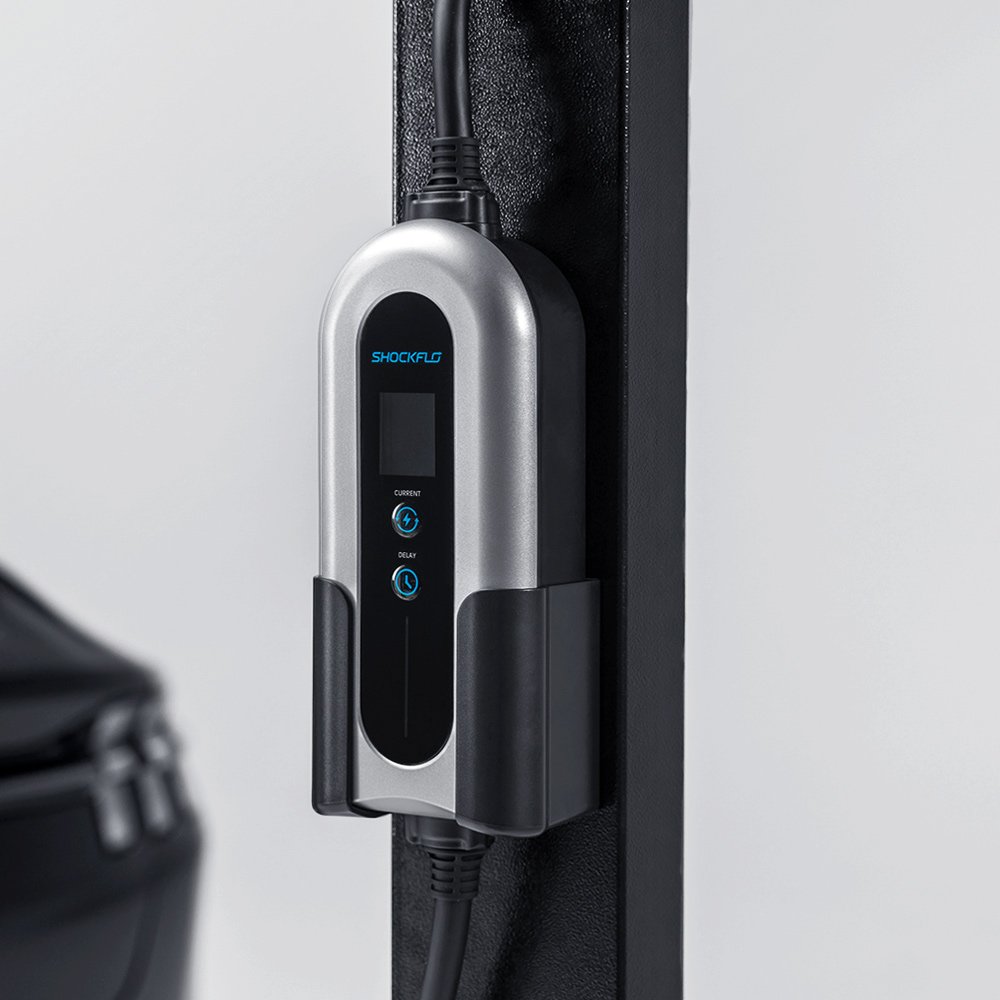
4-wire receptacle with two hot legs, one neutral, and one ground. The standard outlet for RVs, electric ranges, and EV chargers. Most portable Level 2 EV chargers — including all ShockFlo models — use a NEMA 14-50 plug.
NEMA 6-50
3-wire receptacle with two hot legs and a ground — no neutral wire. Common in commercial and industrial settings, and in older residential panels. Some hardwired EV charger installations use this configuration.
Key Differences Side by Side
| Feature | NEMA 14-50 | NEMA 6-50 |
|---|---|---|
| Voltage | 240V | 240V |
| Amperage | 50A | 50A |
| Number of wires | 4 (2 hot + neutral + ground) | 3 (2 hot + ground) |
| Neutral wire present | Yes | No |
| Common residential use | Electric range, RV, EV charger | Industrial equipment, welders |
| ShockFlo charger compatibility | All ShockFlo models | Adapter required |
| Most portable EV charger compatibility | Yes — industry standard | Varies by brand |
| Installation cost (typical) | $200–$400 | $200–$400 |
Why NEMA 14-50 Is the Standard for Home EV Charging
The NEMA 14-50 has become the de facto standard for residential Level 2 EV charging for two reasons. First, the neutral wire it provides allows some chargers and smart home systems to operate certain low-voltage control circuits that a 6-50 cannot support. Second, NEMA 14-50 outlets are already common in American homes for electric ranges and dryers — electricians install them routinely, parts are widely available, and the infrastructure is familiar.
Every portable Level 2 EV charger that ShockFlo manufactures — the Gmini 16A, the G1 40A, and the plug-in mode of the S1 48A — uses a NEMA 14-50 plug. If you are having a new outlet installed specifically for EV charging, a NEMA 14-50 is the correct choice in almost every situation.
When NEMA 6-50 Makes Sense
There are situations where NEMA 6-50 is the better option. If your home already has a NEMA 6-50 outlet installed — from a previous tenant, a welding setup, or an earlier electrical project — using an adapter to connect a NEMA 14-50 charger is a straightforward solution. Adapters are available and safe when rated for the application.
Some older homes also have 6-50 circuits already run to the garage where adding a neutral wire would require significant electrical work. In these cases, choosing a charger designed for 6-50 connectivity (or using an adapter) avoids the cost of rewiring.
For new installations with no existing 240-volt infrastructure, NEMA 14-50 is always the preferred choice.
Can I Use an Adapter Between the Two?
Yes. NEMA 14-50 to 6-50 adapters — and their reverse — are commercially available and safe when used within the amperage rating of both the outlet and the adapter. If you have a NEMA 6-50 outlet but a charger with a NEMA 14-50 plug, a rated adapter resolves the incompatibility without requiring electrical work.
Other 240V Outlets You May Encounter
Beyond 14-50 and 6-50, you may come across other NEMA configurations in residential garages:
- NEMA 14-30: A 30-amp, 4-wire outlet — common for electric dryers. It can charge an EV at reduced amperage with an adapter, but 30A limits charging speed significantly.
- NEMA 6-20: A 20-amp, 240-volt outlet. Too low for most Level 2 chargers at full output, though some lower-amperage models can use it.
- NEMA 10-30: An older 3-wire, 30-amp receptacle found in homes built before 1996. Lacks a ground wire and is not recommended for EV charging without a full circuit upgrade.
When in doubt about which outlet type your home has or needs, a licensed electrician can assess your panel and recommend the correct installation. The difference between a proper installation and a problematic one is rarely worth saving on a professional assessment.
What to Tell Your Electrician
When scheduling an outlet installation for a Level 2 EV charger, give your electrician the following specification: a NEMA 14-50 receptacle on a dedicated 50-amp, 240-volt circuit with a 50-amp double-pole breaker. If you are adding a NEMA 14-50 outlet to an existing garage circuit, confirm that the circuit is dedicated — not shared with other outlets or loads. A shared circuit will cause nuisance trips when both the EV charger and another high-draw appliance run simultaneously.
If you are considering the ShockFlo S1 48A in hardwired mode, specify a 60-amp circuit — the 80-percent safety rule requires a 60-amp breaker to support a 48-amp continuous draw.
ShockFlo G1 40A — NEMA 14-50 Plug-In Ready
Plugs directly into your new NEMA 14-50 outlet. No electrician needed for the charger itself.
Conclusion
For new EV charging installations, NEMA 14-50 is the correct choice in almost every residential scenario. It is the industry standard for portable Level 2 chargers, the most widely available 240-volt receptacle type, and the format used by all ShockFlo plug-in models. If you already have a NEMA 6-50 outlet in place, an appropriately rated adapter allows compatible use with any NEMA 14-50 charger.
Before purchasing a charger, confirm your outlet type — or plan your installation accordingly. The right outlet and the right charger together make the rest of the EV ownership experience straightforward. Explore the full ShockFlo range at our portable EV chargers and home EV chargers pages.
Frequently Asked Questions
Do all ShockFlo chargers use a NEMA 14-50 plug?
Yes. All ShockFlo portable models — the Gmini 16A, G1 40A, and the plug-in configuration of the S1 48A — use a NEMA 14-50 plug. The S1 also supports hardwired installation, which connects directly to the panel without any plug.
Can I charge an EV on a NEMA 14-30 dryer outlet?
Yes, with an adapter — but the 30-amp limit significantly reduces charging speed. A NEMA 14-30 outlet supports a maximum draw of 24 amps under the 80-percent rule. This is adequate for Level 2 charging but slower than the 40A a NEMA 14-50 supports. For regular home charging, installing a proper NEMA 14-50 is the better long-term solution.
Is a NEMA 14-50 outlet the same as an RV outlet?
Yes. NEMA 14-50 is the standard receptacle used at RV parks and campgrounds with 50-amp service. This means your ShockFlo portable charger will work at any campsite or RV park offering 50-amp hookups — a useful capability for travel charging on long road trips.
How much does a NEMA 14-50 outlet installation cost?
Typically $200 to $400, depending on how far the panel is from the installation location and whether any panel upgrades are needed. The outlet itself costs $15 to $30; labor accounts for the majority of the cost. Most licensed electricians complete the installation in two to four hours.