

Most EV owners judge a charger by its cable length, its plug and how many miles it adds overnight. Few think about what sits behind the housing, yet that is where much of a charger’s safety is decided. Every charger depends on one simple rule: current has to stay on the path the designer drew for it. The materials that enforce that rule range from everyday plastics to technical ceramics.
The property that matters most here is dielectric strength, the electric field a material can withstand before it breaks down and starts to conduct. Dry air manages about 3 megavolts per meter, while aluminum oxide is listed at roughly 13.4 MV/m. Those numbers come from test samples under set conditions. Real parts contain tiny flaws, and thicker pieces tend to hold less per millimeter than thin films, so engineers leave a wide margin instead of designing right up to the limit.
The Plastics You Can See and the Ones You Cannot
Much of the insulation in a charger is engineering plastic: the housing, the internal brackets, the bodies of connectors and terminal blocks. Polycarbonate shows why plastics are so popular for this work. It is a good electrical insulator with heat-resistant and flame-retardant properties, and it can be molded into complex shapes. Its limits are just as clear: the upper working temperature sits around 115–130 °C, and standard grades are not meant for long exposure to ultraviolet light.
That temperature ceiling explains why material choices change from one spot to another inside the same device. Plastic handles most low-power areas comfortably. Where parts sit close to heat or high voltage, though, electrical equipment sometimes uses ceramic instead, and this overview of ceramic insulators is a handy place to see alumina, porcelain and steatite compared side by side. Ceramics such as alumina stay rigid at temperatures far beyond anything a charger should ever reach. Their surfaces still need care, because moisture and dirt can lower surface resistivity by several orders of magnitude.
Plastic rarely fails all at once. Years of heat cycling, sunlight and physical stress can make it brittle, and small cracks give dust and water a path inward. Standard polycarbonate is not made for long sun exposure, which is one reason placement matters for a unit mounted outdoors. For an owner, the warning signs are usually easy to spot: discoloration around the plug or housing, warping, a melted look near the pins, or a hot plastic smell during a session.
Where Current Is Densest, Spacing Matters
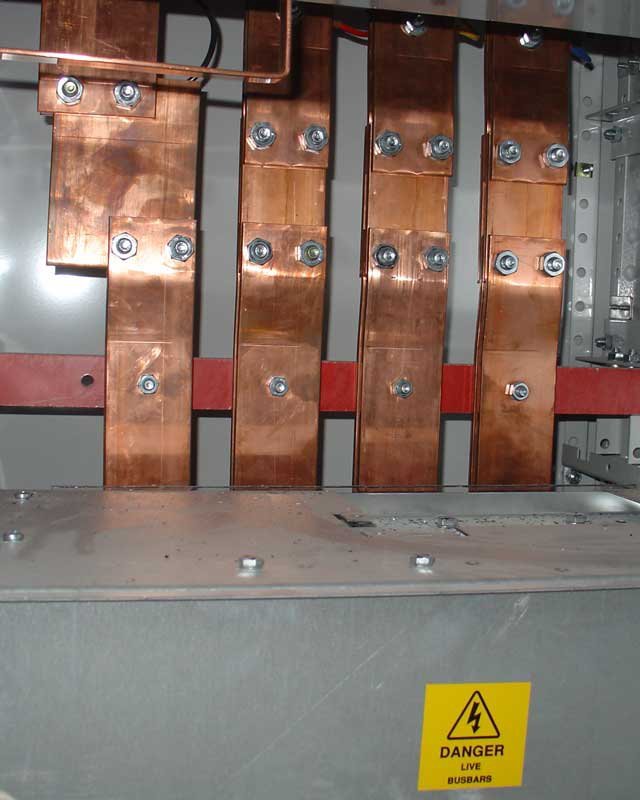
Deeper inside, a charger carries its highest currents through copper conductors such as busbars and terminals. These parts have to be held firmly in place and kept apart, because the gap between two conductors at different potentials is itself part of the insulation. Some of that gap is air, and some of it is a solid support that stops the parts from drifting closer. Heat makes the job harder, since metal expands and contracts every time a charging session starts and ends. Over many cycles, that small movement can work a joint loose, and a loose joint runs hotter than a tight one.
In electrical equipment generally, the fixed blocks that hold busbars apart can be molded nylon or ceramic, with ceramic taking over where parts run continuously hot or face very high voltages. For a closer look at those ceramic parts, this guide to alumina spacers walks through the rod, tube and standoff shapes they come in. Whatever the material, a spacer must keep its shape under load, refuse to conduct, and tolerate the heat that builds up around a high-current joint.
Alumina earns that role for practical reasons. Aluminum oxide is an electrical insulator with a melting point of 2,072 °C, and it is also used to make spark-plug insulators. One detail designers watch closely is expansion: copper grows roughly twice as much as alumina for each degree of temperature rise, so mounts typically leave some room for movement instead of clamping the two rigidly together.
What a Buyer Can Actually Check
None of these parts are visible once a charger leaves the factory, but owners still have useful checks. Look for the safety certification marks listed on the product page or label, and confirm them with the certifying organization when in doubt. Compare the stated operating temperature range with your climate, especially if the unit will hang in a hot garage or on an outside wall. Keep the plug and connector out of standing water, and during the first few sessions check the plug and cable now and then; if either feels hotter than you would expect, stop and contact the manufacturer.
What sits inside the housing decides whether the insulation still works after several summers of heat, a damp winter and years of daily plug-ins. A unit can look spotless while a support inside has cracked or a terminal has worked loose, and the only clues may be extra heat or an odd smell at the plug. That is why a charger that has been dropped, crushed or soaked is worth having checked even if it still powers on.
A few everyday habits help. Store or mount the charger where it stays dry and out of direct sun, keep the plug face clean, coil the cable loosely instead of kinking it, and look over the housing and cable every few months. A portable unit that rides in the trunk deserves the same attention, since it sees more knocks and temperature swings than a wall-mounted one. If the plug looks discolored, the casing has cracked, or a session smells of hot plastic, unplug it at the outlet and ask the manufacturer before you use it again.