

How to Charge a Tesla with a J1772 Charger: Complete Adapter Guide
Tesla vehicles use a proprietary charging connector — but that does not lock you into Tesla-branded charging equipment at home. Every J1772 Level 2 charger on the market, including all ShockFlo models, is fully compatible with Tesla vehicles using a simple adapter. Understanding exactly how the adapter works, what speeds to expect, and which charger to choose will help you set up the best possible home charging arrangement for your Tesla.
Tesla’s Charging Connector Situation
Tesla vehicles sold in North America use the North American Charging Standard (NACS) connector — sometimes called the Tesla connector — for both AC home charging and DC Supercharging. This is a proprietary plug design that differs physically from the J1772 (SAE J1772) connector used by all other EVs sold in North America.
However, Tesla recognized early that not every charging location would have Tesla-specific equipment, so they designed a solution into every vehicle: a J1772 to NACS adapter that ships in the box with every Tesla sold in North America. This adapter plugs into your Tesla’s NACS charge port and accepts a standard J1772 connector, making every J1772 charger compatible with your Tesla at no additional cost.
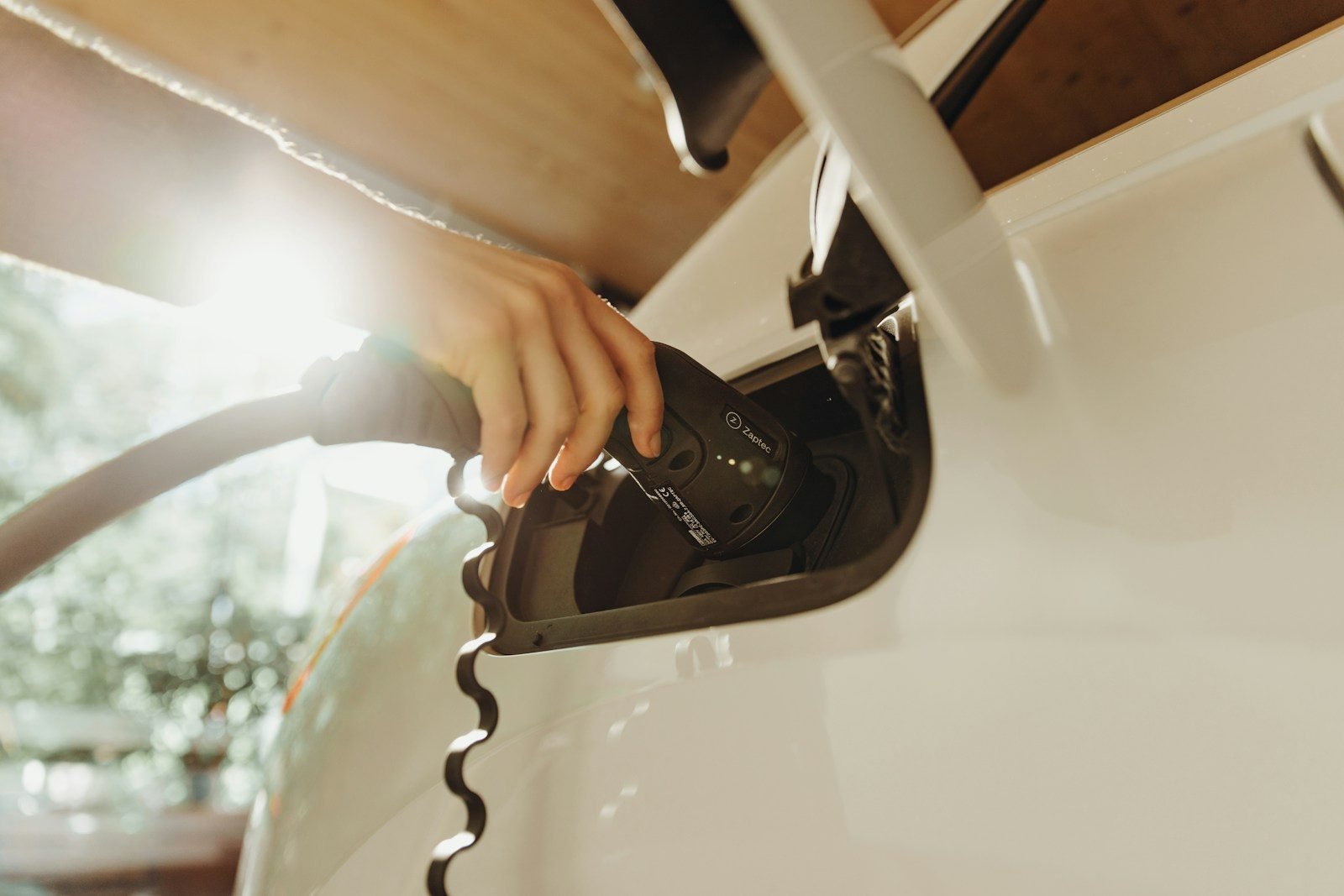
Step-by-Step: Charging a Tesla with a J1772 Charger
- Locate the J1772 adapter in your Tesla’s charging kit. It is a small, cylindrical adapter included in the charging bag that comes with every new Tesla. If you do not have one, Tesla sells replacements through its online store, and third-party adapters are also available.
- Insert the J1772 adapter into your Tesla’s charge port. Open the charge port door (press the button on the port door, use the Tesla app, or press the button on your charging cable). Slide the J1772 adapter into the NACS port until it clicks securely into place.
- Plug the J1772 Level 2 charger into the adapter. Connect the J1772 connector from your ShockFlo charger into the adapter. The adapter accepts the J1772 plug just as a standard J1772 EV would.
- Confirm charging has started. The charge port light on your Tesla will turn green and pulse to indicate active charging. The Tesla app and vehicle dashboard both display the current charge rate and estimated completion time.
- Set your charge limit and schedule in the Tesla app. Configure your preferred charge limit (typically 80–90% for daily use, 100% for long trips) and, if using a ShockFlo smart charger, coordinate schedules between the ShockFlo app and Tesla’s built-in scheduling features.
Charging Speed: What to Expect with Each ShockFlo Model
The charging speed you experience depends on both the charger’s output and your specific Tesla model’s onboard AC charging rate. Tesla vehicles accept different maximum AC charging rates depending on the model and configuration:
| Tesla Model | Max AC Rate | ShockFlo Gmini 16A | ShockFlo G1 40A | ShockFlo S1 48A |
|---|---|---|---|---|
| Model 3 (Standard/LR) | 7.6 kW (32A) | 3.8 kW | 7.6 kW (limited by car) | 7.6 kW (limited by car) |
| Model 3 Performance | 11.5 kW (48A) | 3.8 kW | 9.6 kW | 11.5 kW |
| Model Y (all variants) | 11.5 kW (48A) | 3.8 kW | 9.6 kW | 11.5 kW |
| Model S (current) | 11.5 kW (48A) | 3.8 kW | 9.6 kW | 11.5 kW |
| Model X (current) | 11.5 kW (48A) | 3.8 kW | 9.6 kW | 11.5 kW |
| Cybertruck | 11.5 kW (48A) | 3.8 kW | 9.6 kW | 11.5 kW |
For Model 3 Standard Range and Long Range owners: the vehicle’s onboard charger is rated at 7.6 kW (approximately 32A). A ShockFlo G1 at 40A will charge these vehicles at their maximum rate — you are not losing any speed compared to a 40A Tesla Wall Connector. The S1 48A provides no additional speed benefit for these specific models.
For Model Y, Model S, Model X, and Cybertruck owners: these vehicles accept up to 11.5 kW (48A). The ShockFlo G1 at 40A delivers 9.6 kW — approximately 83 percent of the maximum possible rate, adding up to 30 miles per hour. The ShockFlo S1 48A hardwired reaches the full 11.5 kW, adding up to 44 miles per hour.
J1772 Adapter Options
Tesla OEM Adapter (Included)
- Included free with every new Tesla in North America
- Rated for up to 80A / 240V
- Compatible with all J1772 Level 1 and Level 2 chargers
- Compact, lightweight design
- Replacement cost approximately $35 from Tesla
ShockFlo Tesla Adapter
- Available separately if the OEM adapter is lost or for a backup
- Full J1772 to NACS compatibility
- IP55 weatherproof rated
- Compatible with all ShockFlo J1772 chargers
- Competitively priced below Tesla’s OEM replacement
Scheduling Considerations: ShockFlo App vs Tesla App
Both the ShockFlo charger and your Tesla have scheduling capabilities, and it is worth understanding how they interact.
ShockFlo charger scheduling controls when the charger delivers power. If a schedule is set in the ShockFlo app to start at 11 PM, the charger does not supply power before that time — even if the vehicle is plugged in and requests a charge.
Tesla’s built-in scheduling controls when the vehicle requests power from the charger. If Tesla’s schedule is set to 11 PM, the car signals the charger to begin at that time.
To avoid conflicts and double-scheduling, use one system or the other — not both simultaneously. For most owners, using the ShockFlo charger’s schedule is simpler: set the window once in the app, and it applies regardless of which vehicle is plugged in. This is particularly useful in households with both a Tesla and a J1772 EV.
Is a J1772 Charger or a Tesla Wall Connector Better for Home Use?
Tesla sells its own home charging unit — the Tesla Wall Connector — which uses the NACS connector directly, eliminating the need for an adapter. It supports up to 48A and integrates natively with the Tesla app for scheduling and monitoring.
The practical difference for daily use is small. The adapter adds approximately three seconds to the plug-in process and has no effect on charging speed or battery health. A ShockFlo G1 40A costs $189 and adds 30 miles per hour to a Model Y. A Tesla Wall Connector costs approximately $400 before installation, and adds 44 miles per hour hardwired at 48A.
For households where only a Tesla is charged: the Tesla Wall Connector is a reasonable choice, particularly for Model Y and Model S owners who want to utilize the full 48A rate. For households with mixed EVs — a Tesla and a non-Tesla — a J1772 charger like the ShockFlo G1 is the universal solution that serves every vehicle without any adaptation required on the non-Tesla side.
ShockFlo G1 40A — Works with Every Tesla
Use the included J1772 adapter. Up to 30 mi/hr on Model Y. Ships free from the US.
Conclusion
Charging a Tesla with a J1772 charger is fully supported by the hardware Tesla ships with every vehicle. The included adapter makes any J1772 Level 2 charger compatible in seconds. For most Tesla owners, the ShockFlo G1 40A at $189 delivers the same overnight charging outcome as a dedicated Tesla Wall Connector at a fraction of the price — while also remaining compatible with every other EV that may enter the household. For maximum speed, the ShockFlo S1 48A hardwired reaches the full 11.5 kW ceiling of Tesla’s highest-spec onboard charger.
Frequently Asked Questions
Will using a J1772 adapter void my Tesla warranty?
No. Tesla explicitly supports J1772 charging and includes the adapter with every vehicle for this purpose. Using any UL-listed or certified J1772 charger with the included adapter is within Tesla’s supported charging methods and does not affect your warranty.
Does the J1772 adapter reduce charging speed?
No. The adapter is a passive connector — it contains no active electronics that limit power transfer. Charging speed is determined entirely by the charger’s amperage output and the Tesla’s onboard AC charging rate. The adapter itself introduces no additional speed limitation.
Can I leave the J1772 adapter plugged into my Tesla permanently?
Yes. Many Tesla owners leave the adapter installed on their home charger connector so it is always ready. This is safe and has no effect on either the adapter or the charge port over time.
Which ShockFlo charger is best for a Tesla Model Y?
The ShockFlo G1 40A adds up to 30 miles of range per hour on a Model Y — sufficient to fully charge a Long Range Model Y (82 kWh) from 20 percent overnight. For maximum speed on a Model Y, the ShockFlo S1 48A hardwired reaches the Model Y’s full 11.5 kW onboard charging ceiling.