

Level 1 vs Level 2 EV Charger: Which One Do You Actually Need?
If you just took delivery of your first electric vehicle, one of the first practical decisions you will face is whether the charging cable in the box is adequate — or whether a dedicated Level 2 home charger is worth the investment. The answer depends on how far you drive each day, but once you understand the real difference in speed and daily usability, most EV owners find the upgrade straightforward to justify.
What Is a Level 1 EV Charger?
A Level 1 charger is the compact cable that ships with most electric vehicles. It draws power from a standard 120-volt household outlet — the same type powering a table lamp or a phone charger — and requires no special installation whatsoever. Plug one end into the wall and the other into your vehicle, and charging begins immediately.
The appeal is genuine: you can charge anywhere in the country that has a standard outlet, without any preparation. The limitation is equally clear. At 120 volts and 12 amps of output, a Level 1 charger adds approximately three to five miles of range for every hour it runs. A vehicle with a 60 kWh battery pack, charged from fully depleted, would take 40 to 50 hours to reach full capacity.
In practice, drivers rarely drain their battery entirely. But even recovering 80 miles of range from a 20 percent state of charge can require more than 15 hours on Level 1 — more than a single overnight session reliably provides. For daily drivers, that math compounds into a constant, low-level inconvenience.
What Is a Level 2 EV Charger?
A Level 2 charger operates on a 240-volt circuit — the same voltage that powers a clothes dryer, an electric range, or a central air conditioning unit. Depending on the model, it connects to a dedicated NEMA 14-50 outlet or is hardwired directly into the home’s electrical panel.
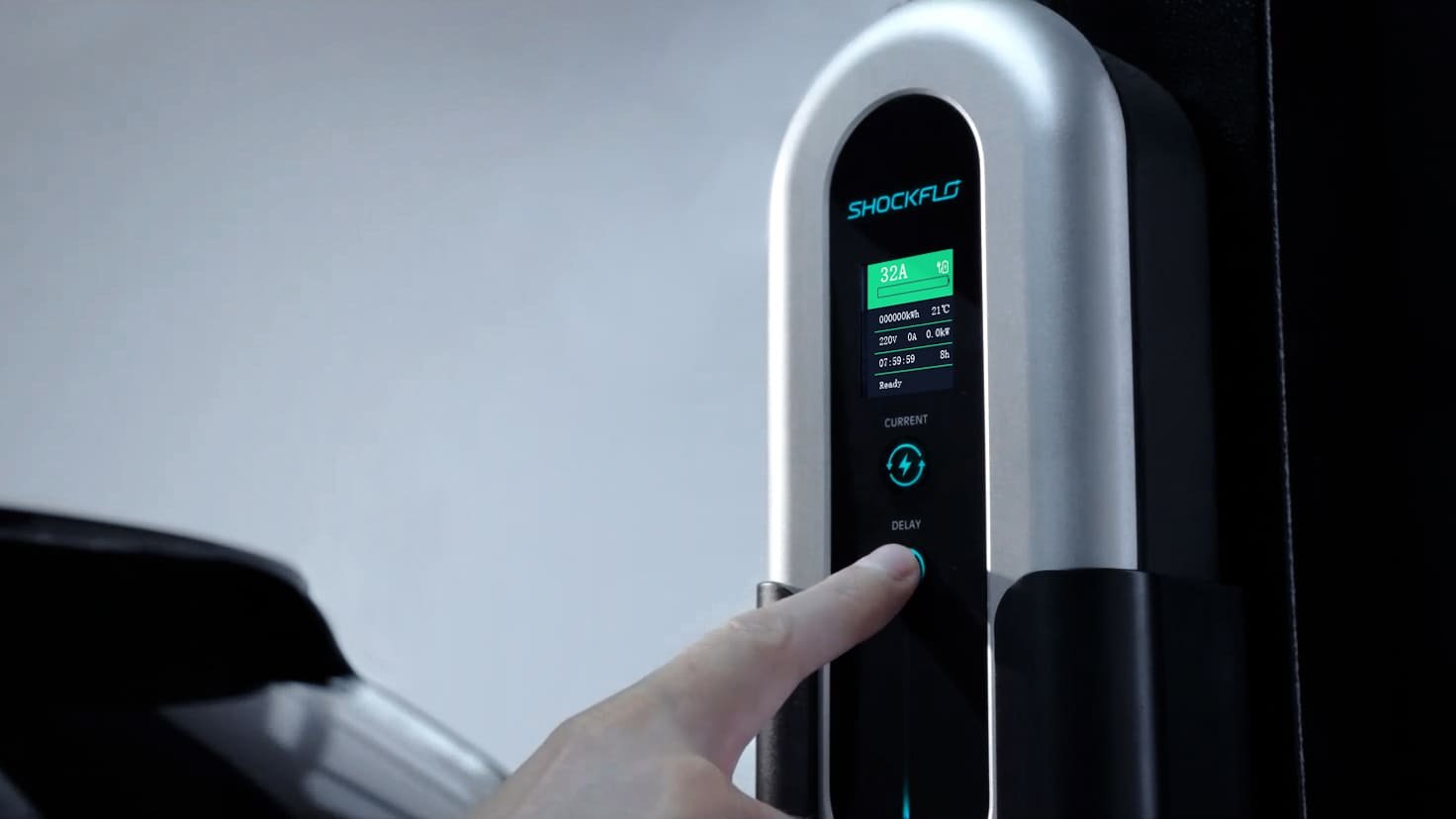
The difference in charging speed is not incremental — it is transformative. A quality 40-amp Level 2 charger such as the ShockFlo G1 delivers 9.6 kilowatts of power, adding up to 36 miles of range per hour. That same 60 kWh battery charges fully in six to eight hours. For most households, this means a full charge completes before dawn — regardless of what time you plugged in the night before.
Side-by-Side Comparison
| Feature | Level 1 | Level 2 |
|---|---|---|
| Voltage | 120V AC | 240V AC |
| Typical amperage | 12–16A | 16–48A |
| Miles added per hour | 3–5 miles | 15–44 miles |
| Full charge time (60 kWh) | 40–50 hours | 6–10 hours |
| Installation required | None | 240V outlet or hardwiring |
| Upfront cost | Included with vehicle | $160–$600 |
| Smart scheduling | Rarely available | Standard on modern units |
| Ideal for | PHEVs, low daily mileage | Full BEVs, most EV owners |
The True Cost of Each Option
The comparison is not simply the purchase price of a Level 2 charger versus the zero cost of the included Level 1 cable. It is the total value delivered over years of ownership.
Most utility companies offer time-of-use electricity rates, where power is significantly cheaper during off-peak hours — typically between 11 PM and 7 AM. A smart Level 2 charger such as the ShockFlo G1 or the ShockFlo S1 allows you to schedule charging sessions automatically during the cheapest window. A basic Level 1 cable offers no such functionality.
In markets where off-peak rates are 40 to 60 percent lower than peak pricing, this scheduling feature alone can generate hundreds of dollars in annual savings. For many owners, a Level 2 charger pays for itself within the first year through electricity cost reduction — before accounting for the daily convenience gained.
When Level 1 Is Genuinely Sufficient
Level 1 charging deserves a fair assessment. There are specific situations in which it is a legitimate daily solution rather than a stopgap.
Plug-in hybrid owners with battery packs under 20 kWh can typically restore a full charge in eight to ten hours on Level 1 — within a standard overnight window. Drivers who cover fewer than 30 miles per day and consistently have 12 or more hours between drives can maintain adequate range on Level 1 without issue.
Level 1 is also the right tool for travel: whenever you are staying somewhere with only a standard outlet, it provides a meaningful trickle charge overnight. It serves as a genuine backup for Level 2 charger owners who occasionally need to charge away from home.
When You Need Level 2
For owners of full battery-electric vehicles — particularly those with 60 kWh or larger battery packs — Level 1 is a daily compromise that compounds over time. The upgrade to Level 2 is the right call when any of the following apply:
- Your daily driving distance exceeds 40 miles
- Your vehicle has a battery larger than 50 kWh
- You want a reliably full battery every morning regardless of when you plugged in
- You want to take advantage of off-peak electricity pricing through scheduled charging
- You find yourself managing charging as a logistical problem rather than a simple overnight habit
Which Level 2 Charger Is Right for You?
Not every Level 2 charger performs equally. The primary variables are amperage output, smart connectivity, build quality, and whether portability matters for your situation.
ShockFlo offers three models suited to different needs. The ShockFlo Gmini 16A adds up to 15 miles of range per hour and is the most affordable entry point at $159.99 — well suited to plug-in hybrid owners and low-mileage EV drivers. The ShockFlo G1 40A adds up to 36 miles per hour with full app control, Wi-Fi and Bluetooth connectivity, RFID access, and an IP65 weatherproof rating, currently available at $189.00. The ShockFlo S1 48A delivers up to 44 miles per hour and supports both plug-in and hardwired installation — maximum performance for high-mileage drivers and larger battery packs.
All three are compatible with every J1772 electric vehicle. For a full comparison of portable options, see our guide to the best portable Level 2 EV chargers.
ShockFlo G1 40A — Most Popular
36 miles per hour. App scheduling, RFID access, IP65 rated. Ships free from the US.
A Note on Installation
Portable Level 2 chargers such as the ShockFlo G1 require a NEMA 14-50 outlet — a 240-volt, 50-amp receptacle commonly found in garages equipped for electric dryers or RV connections. If your garage does not currently have one, installation by a licensed electrician typically costs $200 to $400 and takes two to four hours. This is a one-time expense that improves your EV ownership experience every single day.
For renters or those who prefer flexibility, this is still a practical path. NEMA 14-50 outlets are removable and leave no permanent alteration to the property. And because the ShockFlo G1 is a portable unit rather than a hardwired fixture, it moves with you when you do.
Conclusion
The Level 1 cable included with your vehicle is a capable backup and travel tool. As a primary home charger for a full battery-electric vehicle, it is a daily compromise. For any driver covering more than 40 miles per day in a long-range EV, upgrading to Level 2 is not optional — it is the foundation of a charging routine that consistently works. Explore the full ShockFlo lineup of portable EV chargers and home EV charging stations, all shipping free from US and Germany warehouses.
Frequently Asked Questions
Can a Level 1 cable charge a Tesla?
Yes, but the speed is very slow. Tesla’s Mobile Connector supports both 120V and 240V outlets. For daily home charging of a Tesla, a Level 2 charger is strongly recommended. See our guide on portable EV chargers for Tesla.
Does Level 2 charging damage an EV battery?
No. Level 2 AC charging is the standard recommended by every major EV manufacturer for daily home use. It does not cause measurable battery degradation. Only frequent DC fast charging used in excess may accelerate minor degradation over extended years.
What does a Level 2 charger cost?
Quality Level 2 chargers range from $160 to $600. The ShockFlo Gmini is $159.99. The G1 40A is currently $189.00, reduced from $289.00.
Do I need an electrician?
Only if you do not already have a NEMA 14-50 outlet. Portable models like the ShockFlo G1 plug into an existing outlet with no professional installation required. If the outlet itself needs to be added, a licensed electrician is necessary — typically a straightforward job of two to four hours.